A mill drill earns its place when a drill press feels limiting but a full milling machine feels like overkill. It combines vertical drilling with limited milling capability in one footprint, making it a strong match for hobby machinists, garage tinkerers, and small fabrication shops. The eight machines below span benchtop compact units, brushless DIY options, larger 2 HP floor models, and a power-feed accessory. Match swing, spindle travel, motor power, and spindle taper (the tapered socket at the bottom of the spindle that holds collets and end mills) to the materials and projects you actually cut.
A Closer Look At The Lineup
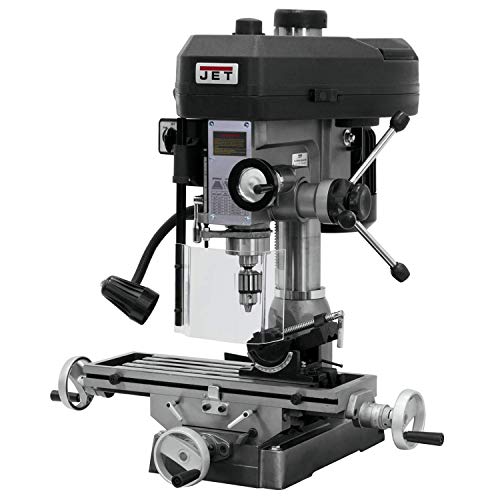
JET JMD-15 15-Inch Mill Drill Machine 1 HP

MechMaxx 6″x20″ Benchtop Mill Drill VM18L
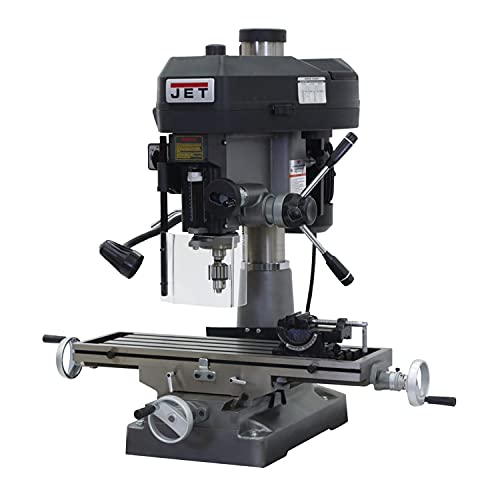
JET JMD-18 18-Inch Mill Drill Machine 2 HP
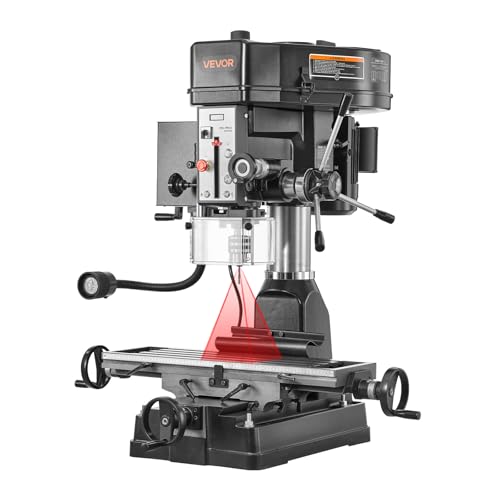
VEVOR 15.875-Inch Mill Drill 2 HP Benchtop

INTBUYING 7″x27-1/2″ Brushless Mini Mill

Grizzly G0705 8″ x 29″ Mill/Drill with Stand
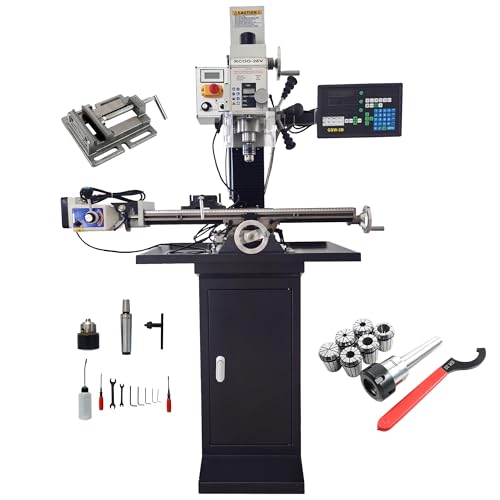
TECHTONGDA 7×27″ Brushless Mill Drill with DRO

SHARS X-Axis Power Feed 110V Reversible
More On The Choices That Made The List
The JET JMD-15 sits in a comfortable middle ground between benchtop hobby mills and full shop machines. Its one-piece cast iron column dampens vibration during cuts, which matters when you are drilling precise holes in steel or milling a small aluminum bracket. A 360-degree head swivel lets you angle the spindle without remounting the workpiece, saving time on compound setups.
Power comes from a 1 HP motor wired for either 115V or 230V, so it can plug into a standard outlet in a home garage. The internal depth gauge and positive quick-stop knob give repeatable drilling depth on production runs. For most small-shop tasks like fixture plates, indexing tables, and prototype brackets, this is a well-rounded centerpiece.
Bright Spots
- Cast iron column and head reduce chatter during milling cuts
- 360-degree head swivel simplifies angled drilling without re-fixturing
- Dual-voltage 115/230V motor adapts to home or shop circuits
- Internal depth gauge supports repeatable hole depth on batch jobs
Trade Offs
- 1 HP may feel marginal when hogging out steel at deeper depths
- Factory warranty coverage varies by region, so check the included paperwork
Made For
Intermediate hobby machinists and small-shop owners cutting steel and aluminum on a regular schedule.
Consider Something Else When
Shops needing maximum torque for heavy steel should consider the JET JMD-18 18-Inch Mill Drill Machine 2 HP instead.
The MechMaxx VM18L addresses a common garage problem: not enough floor space for a 15-inch swing machine. Its compact 6-by-20 inch benchtop footprint fits on a sturdy workbench alongside a grinder or bandsaw. Variable spindle speed from 0 to 2500 RPM lets you dial in the right cutting speed without swapping belts.
The R8 spindle taper is the same industrial standard found on much larger machines, which means a vast ecosystem of collets (sleeves that grip cutting tools by their shank) and end mills fits right in. For DIY machinists cutting small aluminum parts, firearm components, or model parts, the R8 compatibility is a real advantage. You may find the lack of an included stand pushes you toward a custom mount.
Real Benefits
- R8 spindle taper opens access to a wide ecosystem of tooling
- Variable-speed control simplifies tool changes for different materials
- Benchtop footprint suits single-car garage workshops
Some Limits To Know
- Sold without a stand, so you must fabricate or buy a base
- Smaller swing limits workpiece size compared to the JET JMD-15
Whose Shelf It Belongs On
DIY metalworkers working with small parts in a space-constrained garage or basement shop.
Skip It When
Hobbyists needing larger workpiece capacity should reach for the Grizzly G0705 8″ x 29″ Mill/Drill with Stand instead.
Step up from the JMD-15 and you get noticeably more capability. The 2 HP motor handles deeper cuts in mild steel, and the larger 18-inch swing handles workpieces the smaller machine cannot fit. The one-piece cast iron column returns here, giving the rigidity needed for face mill work.
Design touches like the quick-slide belt cover latch, forward-and-reverse switch, and external depth gauge show real shop-floor thinking. You can change spindle speeds without fishing for a screwdriver, and tapping cycles (cutting internal screw threads) become practical with the reversible motor. For dedicated home shops running real production work, this is a clear step up.
Positive Points
- 2 HP motor sustains deeper passes in steel without bogging down
- Quick-slide belt cover cuts speed-change time noticeably
- Reverse switch adds tapping capability for threaded holes
- Larger swing capacity fits bigger workpieces than the JMD-15
Practical Considerations
- Heavier base complicates relocation once positioned
- Larger footprint demands more dedicated floor space
Key Specs
Best Suited To
Small fabrication shops and serious hobbyists cutting steel regularly at deeper depths.
A Better Fit Elsewhere
Those working in tight quarters may find the MechMaxx 6″x20″ Benchtop Mill Drill VM18L a more practical match.
The VEVOR mill drill brings several extras that simplify setup. A crosshair laser projects an aiming point on the workpiece, and an integrated work light illuminates the cutting zone. Both save frustration during layout-heavy jobs where misaligned starting points ruin stock.
The 2 HP motor and 12-speed range from 150 to 2560 RPM cover most wood and light-metal tasks. A rotating vise adds clamping flexibility for round or angled parts. Compared to the MechMaxx VM18L, this model leans more toward the woodworker who occasionally dips into aluminum or thin steel plate.
The Helpful Details
- Crosshair laser speeds up drill-point alignment for layout work
- Work light improves visibility on shadowy shop benches
- Rotating vise holds round and angled parts without custom fixtures
- 12-speed range covers wood, plastic, and light metal
Less Ideal Details
- Plastic knobs and handles feel less durable than cast-metal equivalents
- Documentation and replacement parts can be harder to source than legacy brands
Perfect Match For
Woodworkers and mixed-material hobbyists who want convenience features over pure metal-cutting rigidity.
Look Elsewhere When
Steel-first machinists needing maximum rigidity should look at the JET JMD-18 18-Inch Mill Drill Machine 2 HP.
Brushless motors (motors that use electronic commutation instead of carbon brushes, so they run cooler and last longer) have moved into hobby milling. The INTBUYING RCOG-25V uses a 1.5 HP brushless drive that stays cool under load and skips the brush-replacement chore that plagues brushed mills after a few hundred hours.
The 7-by-27-1/2 inch work envelope supports longer workpieces than the MechMaxx VM18L, while the 50 to 2250 RPM range handles slow steel drilling and faster aluminum milling. R8 spindle taper again keeps tooling options wide open. For most home shops, the brushless upgrade is a meaningful longevity play.
Key Advantages
- Brushless 1.5 HP motor reduces heat buildup and maintenance
- Wide 50 to 2250 RPM range covers steel, aluminum, wood, and plastic
- R8 spindle taper supports standard collets and end mills
- Long table travel handles extended workpieces
Things To Weigh
- Brushless controller electronics can be slower to repair if damaged
- Factory assembly alignment varies, so owners commonly report a break-in tramming process
Quick Facts
Who It Suits Best
Home DIY users working across metal, wood, and plastic who value low maintenance and quiet operation.
Swap It Out When
Shops needing a floor-standing, ready-to-run setup should consider the Grizzly G0705 8″ x 29″ Mill/Drill with Stand.
The Grizzly G0705 is the closest pick in this list to a small-shop workhorse. The 8-by-29 inch table and 15-1/2 inch swing handle long rifle actions, axles, and engine parts that benchtop models cannot accept. It ships with a stand, so it goes straight into a dedicated corner of the shop.
You get a 2 HP motor wired for either 110V or 220V, plus R8 spindle taper and a generous 4-11/16 inch spindle travel for deep drilling. The dual-voltage hookup gives flexibility for shops that upgrade their electrical service later. Compared to the JET JMD-18, the Grizzly leans toward long-workpiece capacity over compact footprint.
Reasons It Performs
- Long 29-inch table handles extended workpieces comfortably
- Included stand removes fabrication time after delivery
- 110V/220V motor adapts to existing shop wiring
- R8 spindle taper supports a deep tooling ecosystem
A Few Limitations
- Mass and footprint rule out apartment or shared-space use
- Setup involves heavier lifting than compact benchtop models
Feature Snapshot
Who Should Grab It
Owners with dedicated shop space who routinely cut long or tall workpieces in steel and aluminum.
Reach For A Different Pick When
Garage hobbyists with limited space will find the MechMaxx 6″x20″ Benchtop Mill Drill VM18L easier to live with.
Digital readouts (DROs) are electronic position displays that replace dial indicators on the axes, and this TECHTONGDA model integrates them at the factory. For machinists who repeatedly return to the same coordinates, a DRO removes the dial-reading step entirely and reduces cumulative error on multi-pass cuts.
The brushless motor, multi-function capability (drilling, flat milling, groove milling, chamfering), and 7-by-27 inch table give you a versatile platform. The stepless X-axis power feed handles long, slow passes smoothly without hand-cranking fatigue. Compared to the INTBUYING RCOG-25V, this model adds digital positioning as the headline feature.
Well-Handled Touches
- Factory DRO speeds up precise, repeatable positioning
- Brushless motor reduces long-term maintenance
- Multi-function head supports drilling, flat milling, and chamfering
- X-axis power feed reduces hand fatigue on long passes
Honest Caveats
- Setup is more involved than a basic drill press
- Replacement DRO components may take longer to source than mainstream brands
Built With In Mind
Machinists producing repeat parts who value digital positioning over manual dial reading.
Another Choice May Suit
Those focused purely on steel cutting and rigidity should consider the JET JMD-18 18-Inch Mill Drill Machine 2 HP.
The SHARS X-axis power feed is not a mill drill on its own. It is an accessory that bolts onto the X-axis leadscrew (the long threaded rod that drives the table left and right) of an existing mill or mill drill and automates table travel. Owners of benchtop mills who hand-crank long passes will recognize the appeal.
Feed rate runs from 0 to 25 inches per minute, which covers most surface milling and slot cutting. Reversible direction lets you start, stop, and back up at the dial. Before ordering, owners commonly report measuring their leadscrew diameter to confirm the 17mm mounting shaft matches.
Where It Excels
- Automates long X-axis passes that tire out hand cranking
- Reversible direction simplifies back-and-forth milling patterns
- 110V operation matches standard home shop outlets
- Compatible with many benchtop mill drill models in this list
Things To Consider
- Requires measuring your leadscrew for fit before purchase
- Mounting hardware and adapters vary by mill model
Feature Card
Right Fit For
Existing mill drill owners who want to add hands-free X-axis travel for longer cuts.
Where A Sibling Pick Shines
Shops starting from scratch with an integrated factory DRO will find the TECHTONGDA 7×27″ Brushless Mill Drill with DRO a more complete platform.
Picking The Right Mill Drill For Your Shop
Mill drills bridge two worlds. They drill like a heavy drill press, and they mill like a small mill. Start by sizing the work envelope to the largest workpiece you realistically expect to hold. Swing (the distance from the spindle centerline to the closest column face) and table travel together define what fits between the spindle and the table.
Motor power matters more than headline horsepower. A 1 HP motor handles aluminum and mild steel at sensible depths. A 2 HP motor adds headroom for harder materials and deeper passes without bogging down. Look at spindle taper compatibility too. R8 is the hobby-industry standard and accepts the widest range of collets and end mills.
Match The Machine To The Material
Cutting aluminum rewards speed and rigidity, so prioritize variable-speed control and a sturdy column. Cutting steel rewards torque and rigidity, so prioritize motor power and mass. Cutting wood rewards work-holding accessories and convenience features like a laser and work light.
Plan For The Footprint And Power
Benchtop machines fit a garage corner but demand a heavy, stable bench. Floor models ship with stands and dominate shop space. Voltage matters as well. A 115V machine plugs into any outlet, while a 230V machine needs a dedicated circuit but draws less current at the same power level.
Think About Tooling And Growth
R8 spindle taper keeps your tooling options open as you grow. Brushless motors (motors that use electronic switching instead of carbon brushes) extend service intervals and run cooler. Accessories like an X-axis power feed save fatigue on long passes once you start cutting real work.
Key Considerations Across These Picks
Pitfalls Shoppers Hit
Choosing a benchtop machine and expecting it to hog steel like a 3 HP Bridgeport sets up disappointment. Choosing a large floor model for tiny hobby parts wastes shop space and money. Skipping measurement of available shop depth and ceiling height has stranded many a delivery at the garage door.
Where The Extra Money Goes
Higher-tier picks add brushless motors for cooler running, integrated DROs for repeatable positioning, and longer tables for bigger workpieces. They also add mass, which improves rigidity and chatter control. For occasional hobby work, a mid-tier machine delivers most of the value. For regular production, the upgrade pays back in time saved and tool wear avoided.
Frequently Asked Questions
What is a mill drill used for? A mill drill combines a drill press and a small milling machine in one unit. You can drill precise holes, face surfaces, cut slots, and perform light milling operations on metal, wood, or plastic.
How is a mill drill different from a drill press? A drill press only pushes a rotating drill bit straight down into the workpiece. A mill drill adds a moveable XY table and stronger spindle, allowing sideways cutting with end mills in addition to vertical drilling.
What spindle taper should I look for? R8 is the hobby-standard spindle taper and accepts the widest range of collets and end mills. Most mill drills in this list use R8, which simplifies tooling decisions.
Can a benchtop mill drill handle steel? Light steel cutting is fine, especially with sharp tools and slower speeds. For heavy steel hogging or extended production runs, a 2 HP floor model with more mass is a safer choice.
Do I need a digital readout (DRO)? A DRO is helpful for repeated cuts and precise positioning, but beginners can work accurately with the factory dials. It becomes more valuable as your projects grow in complexity.
Final Verdict
Match swing and motor power to your biggest realistic project first, then weigh features like brushless motors, DROs, and power feeds against your budget. The picks above cover everything from compact benchtop starters to full shop workhorses, plus one accessory that upgrades an existing setup. Whichever you choose, set it up on a stable surface, verify tram (the alignment of the spindle face to the table), and start with aluminum before moving to steel.