Whether you’re coaxing seedlings through their first true leaves or nursing a mature fiddle-leaf fig back from a nutrient deficiency, the right micronutrients can change the whole trajectory of your plants. Micronutrients are the trace elements plants need in smaller amounts than nitrogen, phosphorus, and potassium, but they’re essential for chlorophyll production, enzyme function, and fruit set. Iron, manganese, zinc, copper, boron, molybdenum, and chlorine all play specialized roles that a basic NPK fertilizer simply won’t cover.
The challenge is figuring out which delivery system fits your setup. Soil-based gardeners, hydroponic growers, and houseplant collectors all have different needs, and a one-size-fits-all approach leaves gaps. This roundup covers ten well-regarded options ranging from all-purpose powders to targeted calcium-magnesium blends and acid-loving plant formulas, so you can match a product to your actual growing situation rather than guess at the garden center.
The Leading Options At A Glance

Jack’s Classic 20-20-20 All Purpose Fertilizer 4lb

Great White Mycorrhizal Fungi 3-in-1 Formula (8 oz)

SUPERthrive Plant Vitamin Solution 1 Pint
Jack’s Nutrients Part A & Cal Nit Part B Bundle

General Hydroponics CALiMAGic Quart

FoxFarm Grow Big Liquid Plant Food Quart

General Hydroponics FloraSeries Trial Pack 1 qt

Supply Solutions Urea 46-0-0 Fertilizer 40 lbs
Supply Solutions 16-16-16 Granular Fertilizer 50 lbs

Supply Solutions Ammonium Sulfate 21-0-0-24S 50 lbs
A Breakdown Of The Leading Choices
If you’re running a mixed collection of houseplants, a window box of herbs, and a small vegetable patch, an all-purpose feed like Jack’s Classic 20-20-20 saves you from stocking five different bottles. The 20-20-20 ratio means equal parts nitrogen, phosphorus, and potassium, the three macronutrients (the nutrients plants need in the largest quantities) plants can’t do without. That balanced profile also carries a built-in dose of micronutrients, so you’re not feeding blind.
The powder dissolves in water, and depending on your approach, you can apply it as a root drench, a foliar spray (misted directly onto leaves for fast absorption), or through a continuous-feed injector. For most home gardeners, that flexibility means one product covers a lot of ground. A 4-pound tub goes a long way: depending on dilution, you can mix several gallons of feed from a single scoop.
Advantages To Know
- The equal NPK ratio works for nearly any plant type, which simplifies feeding routines across mixed collections
- Water-soluble powder format stretches further per dollar than most liquid concentrates
- Works as a foliar spray, a root drench, or a continuous injector feed for greenhouses
- Carries micronutrients alongside the macronutrients, closing the trace-element gap in one application
Things To Consider
- The powder must be fully dissolved before use to avoid uneven feeding or clogged sprayers
- It does not target deficiencies in calcium or magnesium, so calcium-loving crops like tomatoes may need a separate Cal-Mag supplement
Key Product Details
Right Fit For
Beginner-to-intermediate gardeners who want a single product that handles houseplants, herbs, and outdoor beds without juggling multiple bottles.
Consider Something Else When
Serious hydroponic growers should consider the Jack’s Nutrients Part A & Cal Nit Part B Bundle, which is built for reservoir feeding rather than mixed-container gardens.
Great White takes a different approach from the other picks on this list. Rather than feeding the plant directly, it introduces beneficial fungi and bacteria to the root zone. Mycorrhizal fungi form a symbiotic relationship (a mutually beneficial partnership) with plant roots, extending their reach into the soil so the plant can access more nutrients and water than it could on its own.
The 8-ounce container holds a concentrated blend of mycorrhizae plus beneficial bacteria, applied at seeding, transplanting, or as a root dip. For anyone starting seeds indoors or moving seedlings out to the garden, this is a one-time investment in root development that pays off across the plant’s life. Compared to a basic 20-20-20 like Jack’s Classic, this product complements fertilizer rather than replacing it.
What Makes Sense
- Supports nutrient absorption by extending root reach through fungal networks, which can reduce the total fertilizer you need over a season
- Useful at every stage, from seed-starting mix to transplant holes and established root zones
- A small amount goes a long way; 8 oz treats many seedlings or transplants
Points To Note
- It is a soil-and-root enhancer, not a fertilizer, so plants still need a base feed program alongside it
- Stored powder can lose viability in humid sheds, so keeping the container sealed matters
Who It Suits Best
Gardeners who start seeds indoors or transplant seedlings regularly and want stronger root systems from day one.
Look Elsewhere When
Vegetable growers chasing faster top-down growth should pair this with FoxFarm Grow Big, which focuses on lush vegetative foliage rather than root-zone biology.
SUPERthrive has a long history among nursery professionals, and the liquid vitamin concentrate format makes it easy to add to transplant water. The formula includes kelp, which contributes natural hormones and trace minerals that support root recovery. For anyone moving established trees, shrubs, or houseplants into new containers, the goal is reducing transplant shock, and that’s where this product positions itself.
A 1-pint bottle concentrates heavily, so you’re measuring drops per gallon rather than scoops. It’s meant as a supplement, not a primary fertilizer, and pairs well with a base NPK program. For gardeners who regularly move larger plants or establish new ones, the bottle size and dilution rate tend to last across many plantings.
The Value In It
- Highly concentrated liquid, so a small bottle covers many transplanting sessions
- Includes kelp-derived vitamins and hormones, which can ease root stress during moves
- Versatile across ornamentals, edibles, and even cut-flower maintenance
Trade Offs
- It is not a standalone fertilizer, so it works best alongside a base feeding program
- Measuring small amounts from a bottle can be fiddly if you’re diluting large watering cans
Feature Snapshot
Best Suited To
Gardeners who transplant mature trees, shrubs, or large houseplants and want to reduce the stress that comes with root disturbance.
Skip It When
Anyone wanting a single-bottle fertilizer-and-micronutrient combo should default to Jack’s Classic 20-20-20 instead, since SUPERthrive needs a base feed.
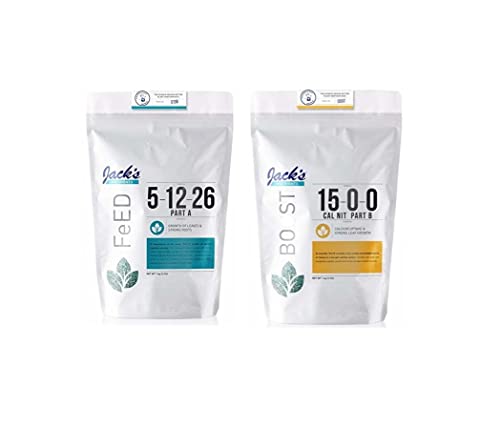
Hydroponic setups need a different nutrient structure than soil gardens because there’s no soil buffer holding reserves of trace elements. Jack’s Nutrients Part A delivers a 5-12-26 NPK ratio along with micronutrients, while the Cal Nit Part B (15-0-0) supplies calcium and nitrogen that can’t be combined in the same dry bag without reacting. Splitting them keeps the formula stable until you mix them into the reservoir.
The bundle includes one 2.2-pound bag of Part A and one 2.2-pound bag of Part B, which together feed a small-to-medium reservoir for a full growing cycle. For hobby hydroponic growers running leafy greens, herbs, or compact fruiting crops, the two-bag system offers more control than a single all-purpose powder. Compared to the General Hydroponics FloraSeries Trial Pack later in this list, this one trades three-part staging for a simpler two-part mix.
A Few Strong Suits
- Two-part design keeps calcium and sulfate separate until the moment of mixing, preventing lockout
- Part A carries micronutrients specifically balanced for hydroponic uptake
- Bundle format removes the guesswork of matching complementary fertilizers
Honest Caveats
- Reservoir pH still needs monitoring; the formula doesn’t auto-buffer
- Less flexibility than three-part systems for fine-tuning bloom versus vegetative stages
Feature Snapshot
Whose Shelf It Belongs On
Hobby hydroponic growers running leafy greens or short-cycle fruiting crops who want a clean, two-bag feeding system without buying a full three-part kit.
Swap It Out When
Growers who want stage-specific nutrient control should consider the General Hydroponics FloraSeries Trial Pack, which separates vegetative and bloom feeding into distinct bottles.
Calcium and magnesium deficiencies show up in frustrating ways: blossom end rot on tomatoes, tip burn on lettuce, and yellowing between leaf veins. CALiMAGic delivers both secondary nutrients (elements plants need in moderate quantities, between macronutrients and micronutrients) in a concentrated liquid that’s easy to add to any feeding program. It’s compatible with most hydroponic base nutrients and works in soil gardens too.
The quart size suits serious growers with multiple reservoirs or large container setups. For tomato and pepper growers, this often becomes a standing addition once fruits start forming, since calcium demand spikes during fruit development. Compared to a broader fertilizer like FoxFarm Grow Big, CALiMAGic is targeted rather than comprehensive.
Good Reasons To Consider
- Concentrated calcium and magnesium in one bottle, addressing the two most common secondary deficiencies
- Liquid format mixes cleanly into reservoirs and watering cans without chalky residue
- Works across hydroponic and soil-based growing systems
- Targeted formula helps prevent blossom end rot and tip burn in calcium-intensive crops
Minor Gripes
- It is a supplement, not a complete fertilizer, so it needs to be paired with a base NPK program
- Overdosing can lock out other nutrients, so measuring carefully matters
Made For
Tomato, pepper, and lettuce growers who keep running into blossom end rot or tip burn despite regular fertilizing.
Another Choice May Suit
Hydroponic growers wanting all-in-one nutrient staging should look at the General Hydroponics FloraSeries Trial Pack, which includes calcium within its base micro formula.
FoxFarm Grow Big is built for the leafy phase of plant growth. The 6-4-4 NPK leans toward nitrogen, which is the macronutrient that fuels leaf and stem development, making it well-suited to early-season vegetables, container roses, and foliage plants. The liquid concentrate is easy to measure and mix, and it carries micronutrients alongside the macronutrients.
For gardeners running container tomatoes or peppers through their vegetative stage before switching to a bloom-focused feed, Grow Big handles the early stretch. The quart size is right for mid-sized collections: enough to last a full season for a balcony garden, light on storage space, and simple to dose. It’s a different profile from the all-purpose 20-20-20 of Jack’s Classic, since this one is staged.
Noteworthy Benefits
- Nitrogen-leaning ratio supports rapid vegetative growth in vegetables and ornamentals
- Liquid concentrate mixes without residue, ideal for hand-watering container gardens
- Includes micronutrients, so it covers trace elements during the leafy phase
Points To Keep In Mind
- Low phosphorus and potassium make it a poor choice as a standalone bloom feed
- Quart containers are bulky compared to powders and take up more storage space
Best Suited To
Container vegetable and flower gardeners who want lush foliage before the flowering stage and prefer liquid mixing over powder dissolution.
Reach For A Different Pick When
Gardeners wanting an all-purpose single-bottle solution should default to Jack’s Classic 20-20-20, which balances vegetative and bloom needs in one feed.
The FloraSeries splits feeding into three bottles, each tuned to a different growth stage. FloraMicro supplies nitrogen, calcium, and chelated micronutrients (micronutrients bound to organic molecules so plants can absorb them efficiently) that anchor the system. FloraGro handles vegetative growth, and FloraBloom shifts the balance toward phosphorus and potassium for flowering and fruiting.
This three-part approach gives experienced growers precise control over nutrient ratios at each phase. The trial pack ships one quart of each, which is a manageable starter size for someone new to staged feeding. Compared to the two-bag Jack’s Nutrients Bundle earlier in this list, FloraSeries trades simplicity for granularity.
The Upside
- Three bottles let you tune vegetative and bloom ratios independently rather than averaging across one formula
- FloraMicro carries chelated micronutrients, which improves uptake in slightly alkaline reservoirs
- Trial-pack size lets you test the system before committing to larger bottles
Softer Spots
- Three bottles mean more measuring and more storage space than a two-bag system
- The learning curve is steeper for first-time hydroponic growers
Quick Facts
Who Will Love This
Hobby hydroponic growers who want stage-specific control and don’t mind the extra measuring that comes with a three-bottle system.
A Better Fit Elsewhere
Soil-based and container gardeners would do better with the simpler, all-purpose Jack’s Classic 20-20-20, which doesn’t require staged feeding.
Urea is a straight nitrogen source with a 46-0-0 analysis, meaning it contains nitrogen and nothing else. For lawns, leafy vegetables, and any plant in a rapid green-up phase, that single-minded nitrogen push can drive growth faster than a balanced fertilizer. The 40-pound bag is sized for larger properties or full-season feeding programs.
This isn’t a balanced garden fertilizer, and it isn’t trying to be. For growers correcting yellowing lawns, boosting corn, or pushing leafy greens, urea fills a specific role. Pair it with a balanced fertilizer like the Supply Solutions 16-16-16 later in this list for crops that need more than nitrogen during the season.
What Earns Its Place
- 46% nitrogen concentration delivers a strong green-up effect at relatively low application rates
- Granular form spreads easily with broadcast spreaders across lawns and large beds
- Bulk 40-pound bag suits full-season programs without frequent reordering
Where It Is Less Suited
- Zero phosphorus and potassium means flowering and fruiting crops will need supplemental feeding
- Urea can volatilize (escape as gas into the air) if left on the soil surface without watering in, reducing efficiency
- Heavy bag requires dry, secure storage to prevent caking
Built With In Mind
Lawn owners and large-scale vegetable growers who need a pure nitrogen source for green-up and leafy growth phases.
Where A Sibling Pick Shines
Gardeners wanting a single bag with N, P, and K included should look at Supply Solutions 16-16-16 Complete, which covers all three macronutrients.
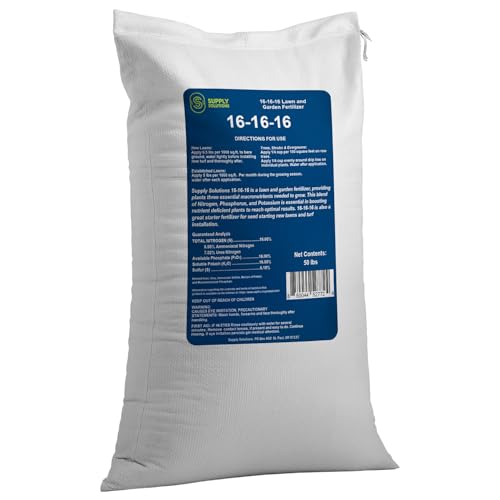
For gardeners covering a lot of ground, a granular 16-16-16 fertilizer handles vegetables, berries, ornamentals, and lawn touch-ups from the same bag. The equal ratio of nitrogen, phosphorus, and potassium suits general feeding across a mixed landscape, and the granular format spreads evenly with a broadcast spreader or by hand in smaller beds.
The 50-pound bag is sized for serious gardens and small farms. Compared to the water-soluble Jack’s Classic 20-20-20 earlier in this list, this one trades quick foliar feeding for slow-release granular coverage that breaks down over weeks. It pairs well with micronutrient-specific supplements like CALiMAGic when calcium or magnesium demand spikes mid-season.
Notable Upsides
- Equal NPK ratio suits mixed plantings, so one bag covers multiple garden zones
- Granular format breaks down slowly, providing weeks of feeding from a single application
- Bulk 50-pound size handles full-season programs for large gardens
Less Ideal Details
- Granular application requires spreading and watering in, which is slower than liquid feeds
- Heavy bag demands dry, accessible storage and a spreader for even application
Feature Rundown
Perfect Match For
Large-property gardeners and small-farm growers who want a single granular bag that handles vegetables, berries, and ornamental beds.
Not Your Match When
Container and houseplant growers should skip the bulk granular format and choose Jack’s Classic 20-20-20, which mixes fresh for smaller-scale watering.
Acid-loving plants like blueberries, azaleas, camellias, and rhododendrons struggle when soil pH climbs above their preferred range. Ammonium sulfate delivers nitrogen plus 24% sulfur, and the sulfur gradually acidifies the surrounding soil as it breaks down. For gardeners with alkaline soil or established beds where these ornamentals keep yellowing, this combination addresses both nutrition and pH at once.
The 50-pound bag suits established blueberry patches and ornamental hedges. It contrasts with a balanced 16-16-16 like the previous Supply Solutions pick, since this one is purpose-built for a specific plant group. If your soil is already acidic, the sulfur component becomes unnecessary, and a different nitrogen source may be the simpler choice.
Everyday Wins
- Combined nitrogen and sulfur delivery feeds acid-loving plants while gradually lowering soil pH
- Granular format spreads easily around shrubs and into blueberry rows
- Bulk 50-pound bag handles established ornamental hedges for multiple seasons
Factors To Consider
- Lowering soil pH too aggressively can harm nearby plants that prefer neutral or alkaline conditions
- Single-nutrient profile means phosphorus and potassium must come from a separate fertilizer for fruiting shrubs
The Right Fit
Blueberry, azalea, camellia, and rhododendron growers dealing with alkaline soil or persistent yellowing from pH-related iron lockout.
Where Another Pick Suits Better
Vegetable gardeners with diverse crops should default to Supply Solutions 16-16-16, which won’t shift pH for non-acid-loving neighbors.
Factors To Weigh When Choosing Micronutrients for Plants
The first question to answer is whether you need a complete fertilizer or a targeted supplement. A general NPK powder like Jack’s Classic 20-20-20 or the Supply Solutions 16-16-16 covers most home gardens without much thought, but hydroponic systems, calcium-intensive crops, and acid-loving ornamentals each need something more specific. Hydroponic growers should match the nutrient format to their reservoir; staged three-part systems like FloraSeries give more control, while two-part bundles like Jack’s Nutrients simplify measuring.
Delivery format matters more than people expect. Water-soluble powders stretch further per dollar but require dissolving before each feeding. Liquid concentrates mix instantly but take up more storage space. Granular fertilizers cover larger areas with less measuring but break down slowly, which suits outdoor beds but not quick-turnaround container gardens. For indoor houseplants, foliar sprays offer the fastest uptake when leaves are showing deficiency symptoms.
The third consideration is the secondary and micronutrient profile. Most all-purpose fertilizers carry some trace elements, but calcium, magnesium, and iron are common deficiencies in specific crops. Tomato and lettuce growers frequently need a Cal-Mag supplement, while acid-loving plants often require sulfur-based fertilizers to keep soil pH in range. Reading the analysis numbers, like 21-0-0-24S, helps decode what each bag actually delivers beyond the headline NPK.
Key Considerations Across These Picks
Pitfalls Shoppers Hit
The most common mistake is treating all fertilizers as interchangeable. A high-nitrogen urea pushes lawns but starves tomatoes of the phosphorus they need for fruit set, while an acidifying ammonium sulfate damages plants that prefer neutral soil. Matching the product to your specific crop and soil pH matters more than chasing the highest analysis number.
Another frequent misstep is overdosing liquid concentrates. Measuring cups seem forgiving, but excess nutrients build up in soil and reservoirs, locking out other elements and burning roots. Following label rates and tracking feeding schedules keeps plants in the safe zone.
What Separates Premium From Basic
The jump from basic to premium usually means better chelation (the process of binding micronutrients to organic molecules so plants can absorb them more easily) and broader micronutrient coverage. Cheaper fertilizers often supply only the headline NPK, leaving gardeners to chase deficiencies with separate products. Premium formulations bundle chelated iron, manganese, zinc, and copper in ratios plants can actually absorb.
The other difference is staging. Three-part systems like FloraSeries let growers adjust ratios for each growth phase, while single-bag fertilizers average everything across the season. For hobbyists with a small setup, that extra control rarely justifies the cost; for growers tuning bloom versus vegetative output, it can be the deciding factor.
Frequently Asked Questions
What are micronutrients for plants and why do they matter?
Micronutrients are trace elements like iron, manganese, zinc, copper, boron, and molybdenum that plants need in small quantities. They drive enzyme function, chlorophyll production, and flower development, and a deficiency in any one of them can stall growth even when NPK levels look fine.
How do I know if my plants need a micronutrient supplement?
Yellowing between leaf veins, distorted new growth, blossom end rot, and poor fruit set are common signs. A soil test is the most reliable way to confirm which micronutrient is lacking before adding supplements.
Can I use the same fertilizer for indoor and outdoor plants?
All-purpose formulas like 20-20-20 work across both, but indoor plants usually need diluted feeds since container volume limits nutrient buffering. Outdoor beds tolerate stronger applications, especially with slow-release granular formats.
Are organic and synthetic micronutrients different?
Synthetic chelated micronutrients offer faster uptake and consistent availability, while organic sources release nutrients slowly as soil biology breaks them down. Both work; the choice depends on how quickly you need results.
How often should I apply micronutrients?
Most home gardens do well with feeding every two to four weeks during active growth. Hydroponic reservoirs typically need replenishment every seven to ten days, since plants absorb nutrients continuously in recirculating systems.
Final Verdict
The right micronutrient product depends less on brand and more on what you’re growing and where. For most mixed gardens, an all-purpose feed covers the basics; for hydroponic systems, staged nutrients give you the control that recirculating water demands; and for acid-loving ornamentals or calcium-hungry vegetables, targeted supplements fill the gaps that general fertilizers leave behind. Match the product to the planting, and the rest tends to take care of itself.