Plants in dim corners don’t have to stay pale and leggy forever. A well-chosen grow light turns a north-facing shelf or a basement nook into a thriving little ecosystem, matching the wavelengths your greenery needs to photosynthesize (the process plants use to convert light into energy for growth) even when natural sun barely shows up. The trick is matching the fixture to the space you actually live in, not the fantasy setup on the product page. This roundup walks through ten options built for different rooms, plant collections, and skill levels, so you can stop guessing and start growing.
The Choices Worth Comparing

GLOWRIUM 48W Grow Light with Stand
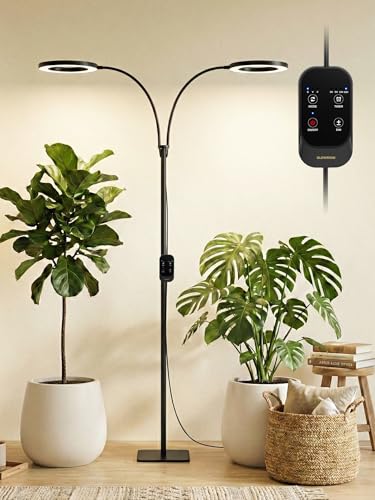
GLOWRIUM Tall Plant Grow Light Full Spectrum

GLOWRIUM Grow Light with Stand

GLOWRIUM Smart Full Spectrum LED Grow Light (Black 4-Pack)

VIIVUU Clip-On Grow Light

Soltech Aspect Gen 2 Pendant Grow Light
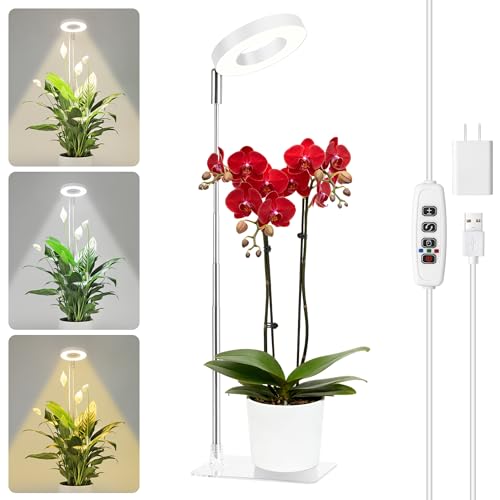
Hywyimlait Halo Grow Light with Adjustable Stand

Hywyimlait Halo Ring Grow Light (2-Pack)

VIPARSPECTRA 70W Dimmable LED Grow Light

Hywyimlait 2-Head Clip Grow Light with Gooseneck
Meet The Standout Selections
Standing at up to roughly 79 inches with a four-section telescoping pole, this GLOWRIUM setup solves a problem most clip-on lights cannot: a tall floor plant that needs light from above without you mounting anything to the ceiling. The lamp head throws a broad, even footprint thanks to the widened design, so a single fiddle leaf or a corner cluster of pothos gets bathed in usable light rather than a narrow spotlight.
Stepless dimming means you can dial the intensity down for a shade-tolerant calathea and crank it back up for a leafy monstera pushing out new fenestrations (the natural splits and holes that develop in mature leaves). Three preset spectrum modes cover seedling, vegetative, and flowering phases, which makes this light useful from the moment you start a seed tray through to a mature specimen. In most apartments, the build feels sturdy enough for daily repositioning.
Key Advantages
- Four-section pole reaches roughly 79 inches for tall floor plants
- Stepless dimming lets you fine-tune intensity for shade lovers and sun seekers alike
- Three spectrum modes (seedling, vegetative, flowering) cover a plant’s entire life
- Widened lamp head spreads light across multiple pots instead of one
Things To Consider
- Floor footprint can crowd tight apartments, depending on your room layout
- Higher pole settings need occasional re-tightening, owners commonly report
Feature Snapshot
Best Suited To
Houseplant parents with a mix of tall and mid-sized plants who want one fixture to rule them all.
Consider Something Else When
The Soltech Aspect Gen 2 Pendant Grow Light suits renters who’d rather mount overhead than place a stand on the floor.
Where the first GLOWRIUM leans on a single wide bar, this model splits the output across two heads running on roughly 268 LEDs total, giving you more directional flexibility. The floor-standing frame reaches about 70.9 inches, which is plenty for a bird of paradise or a cluster of large monsteras. Independent aiming means one head can highlight a tall plant while the second grazes a lower shelf.
Dedicated seedling, vegetative, and flowering spectrum settings keep the wavelengths matched to where each plant is in its lifecycle, instead of a one-size-fits-all glow. The double-head design also helps fill awkward corners where a single beam would leave shadows, and the frame’s footprint stays slim enough for most living rooms. For growers nurturing both propagation trays and mature houseplants, this is a sensible middle ground.
Useful Touches
- Dual heads let you aim at two plants or heights at once
- 268-LED count across both heads gives serious coverage
- Three growth-stage spectrum settings avoid guesswork
- Slim stand footprint fits beside furniture
Worth Noting
- Two heads mean two cables to manage behind the stand
- Tallest height setting may feel tippy in busy households, depending on floor level
Made For
Plant collectors juggling a propagation tray and a mature floor plant at the same time.
Not Your Match When
The VIPARSPECTRA 70W Dimmable LED Grow Light is a smarter pick for growers who need a hanging panel over a dedicated shelf instead of a floor stand.
This earlier GLOWRIUM entry keeps things uncomplicated: a three-section detachable pole that climbs to about 63 inches, a 360-degree rotating lamp head, and three preset spectrum modes covering warm white for germination, mixed warm/red for flowering, and full spectrum for general use. Beginners tend to appreciate that the spectrum runs from 380 to 780 nanometers (a wavelength range that roughly matches what plants use for photosynthesis), without a steep learning curve.
The 6-level dimmer and 3/9/12-hour timer handle the basics of consistent daily light without leaving a light on all night. It works best as a starter stand for a small grouping of pots, and the modular pole means storage is straightforward during a move. In our view, it’s the friendliest entry point in the lineup for someone who hasn’t grown under lights before.
Well-Handled Touches
- Three preset modes cover germination through flowering
- 360-degree rotating head targets plants from any angle
- 6-level dimming and 3/9/12-hour timer automate daily cycles
- Detachable pole sections make it easy to store or move
Trade Offs
- Lower max height than the taller GLOWRIUM stands, so it caps out for big floor plants
- Six discrete dim steps feel coarse compared to stepless models
Quick Facts
Who It Suits Best
First-time grow-light owners who want a forgiving, three-mode setup without a steep cost.
Look Elsewhere When
The Hywyimlait 2-Head Clip Grow Light with Gooseneck is a better fit for bookshelves where a tall stand would look out of place.
Where the other GLOWRIUM entries in this roundup rely on physical controls, this smart bundle dials in light intensity through an app from 1% to 100%, letting you tweak brightness for ferns, succulents, and seedlings without walking up to a button. Four bulbs in the box make it a natural fit for a multi-shelf setup, a long bookcase, or a propagation rack where each shelf wants independent control.
The black housing blends into darker interiors more easily than the white finishes elsewhere in the list, which matters when a light is part of a visible room rather than tucked behind foliage. Smart scheduling also reduces the daily fiddle factor. You may find the app setup takes patience if your home network is older, but once it’s running, automation replaces most manual adjustments.
Reasons It Performs
- App-controlled 1%–100% dimming for plant-by-plant tuning
- Four-pack design lights up an entire shelf at once
- Black finish disappears into dark interiors
- Scheduling reduces daily manual adjustments
Honest Caveats
- App setup may feel fiddly for anyone avoiding smart-home gear
- Four bulbs plus a hub use more outlets than a single-fixture setup
Right Fit For
Tech-forward plant parents running multiple shelves who want fine-grained, app-based light control.
A Better Fit Elsewhere
The VIIVUU Clip-On Grow Light is a smarter pick for someone who just needs one bulb over a single desktop plant.
Tiny grow spaces usually need a tiny solution, and VIIVUU’s clip-on design leans into that with a strong clamp you can grip onto a pot rim, a desk edge, or even a thin shelf. A hollow ring lamp head keeps the weight down so the clamp holds steady, and the same unit ships with a soil-insertion stake for a different mounting style on taller single pots.
It’s the kind of light that quietly does its job on a bedside table next to a single pothos or a windowsill herb starter. You won’t flood a room with it, but for one or two plants, the focused output is exactly right. The honest take is that this works best as a single-purpose light, not as the backbone of a full room setup.
Standout Benefits
- Strong clamp grips pot edges and desks securely
- Includes a soil-insertion stake for taller single pots
- Hollow ring head keeps weight low for stable clamping
- Compact size fits nightstands and small shelves
Points To Note
- Single-light output won’t cover more than one or two pots
- Clamp position needs re-checking on rimless or smooth planters
Spec Overview
Who Will Love This
Desk workers and apartment dwellers nurturing a single small plant that needs a focused light boost.
Swap It Out When
The Hywyimlait Halo Ring Grow Light (2-Pack) is a better fit for two or more plants sharing a small shelf.
The Aspect Gen 2 treats a grow light like a piece of pendant lighting, hanging from the ceiling over a plant rather than standing or clipping next to one. Soltech designed it to look like a real living-room fixture, with a warm-white glow that doesn’t shout “grow tent” to guests. It delivers noticeably more usable plant light than the earlier Small Aspect, helping indoor plants stay fuller in a dim corner.
Dimmable output means you can dial brightness to match the room’s mood without blasting your plants. The catch is installation: you need a ceiling hook or a hardwired junction box, so renters should check with a landlord before committing. For anyone who treats plant care as part of interior design, this is the most decorative pick in the lineup.
Where It Delivers
- Pendant design doubles as a real ceiling light fixture
- Warm-white output blends with living-room aesthetics
- Higher plant-usable output than the previous Aspect model
- Dimmable for both plant cycles and room mood
Potential Drawbacks
- Ceiling mounting is more involved than a clip or stand
- Renters may need landlord approval before drilling
Perfect Match For
Design-conscious plant parents treating their living room as a styled, plant-friendly space.
Another Choice May Suit
The GLOWRIUM 48W Grow Light with Stand is easier for renters who can’t modify the ceiling.
This halo design flips the usual grow-light formula by offering two installation methods in one box: a telescopic pole that inserts directly into soil, or a small base that holds the light over a tabletop pot. That flexibility makes it equally useful on a kitchen counter herb pot, a reading-nook pothos, or a propagation jar. The 48-LED ring keeps the form factor small while still spreading light across the foliage below.
Three light spectrums and ten brightness levels give finer control than basic on/off lights, and the auto timer covers 3/9/12-hour cycles. The honest read is that the modest wattage is best for one to three small plants, not a full shelf. You may find the soil-insertion method wobbles on lighter soil mixes, but the base option steadies things up nicely.
The Helpful Details
- Two-in-one installation: telescoping pole or tabletop base
- 10 brightness levels and 3 spectrums offer finer tuning
- 3/9/12-hour auto timer for hands-off daily cycles
- Compact 48-LED ring footprint for small spaces
Where It Is Less Suited
- Lightweight pole may wobble in very loose soil
- Single ring suits only one to three small plants at a time
Built With In Mind
Countertop herb growers wanting a tidy light that doubles as a small accent piece.
Reach For A Different Pick When
The Hywyimlait Halo Ring Grow Light (2-Pack) is a smarter fit if you want two halo lights covering a small shelf.
Two halo rings in one box let you flank a small shelf or a pair of side tables without fighting for outlets. Each ring runs on a 5V 2A adapter and tilts to direct output, so you can angle them inward toward a shared plant or outward to cover two separate ones. The combination of red, blue, and yellow LEDs aims to deliver a balanced full spectrum for foliage and roots alike.
Timers cover the same 3/9/12-hour cycles as other lights in this roundup, paired with ten dimming levels for finer intensity control. The design also pulls double duty as a small accent piece, since the rings look more like modern decor than industrial gear. One thing to weigh is that the 5V power limit keeps output modest, which is fine for small succulents but light for heavy feeders.
Useful Strengths
- Two rings cover more plants with one purchase
- Red, blue, and yellow LEDs combine for a balanced spectrum
- 10 dimming levels and 3/9/12-hour timer built in
- Modern halo design reads more like decor than gear
Points To Keep In Mind
- 5V input caps output for demanding foliage plants
- Two adapters mean two outlets, depending on shelf layout
Whose Shelf It Belongs On
Renters with a small shelf of plants who want tidy decor-friendly lights without rewiring.
Skip It When
The VIPARSPECTRA 70W Dimmable LED Grow Light suits growers with a dedicated rack who need much higher output.
When “a small boost” stops being enough, a panel-style light like this VIPARSPECTRA steps in. It throws around 11,000 lumens from a scientifically tuned diode arrangement (a deliberate LED placement pattern that spreads usable wavelengths evenly across the canopy), paired with a balanced mix of 660nm red, 3000K warm white, and 5000K cool white light. That combination covers the wavelengths seedlings and vegetative plants actually use, without the purple-only look of cheaper blurple panels.
Dimmable output means you can crank it for leafy greens and tone it down for herbs that scorch easily, and the integrated heat-dissipation layout helps the diodes stay cool during long daily cycles. This is a hanging panel rather than a floor unit, and the assumption is that you have a small rack, a closet, or a corner shelf you can mount over. For most casual houseplant owners, it’s overkill. For serious growers, it’s the right tool.
Notable Upsides
- Around 11,000 lumens for serious seedling propagation
- Balanced red and dual white spectrum avoids the harsh purple look
- Dimmable output adapts to delicate and hungry plants
- Heat-dissipating layout supports long daily runtimes
Some Limits To Know
- Panel style needs hanging hardware and a dedicated spot
- Higher output than casual houseplants generally require
Feature Snapshot
The Right Fit
Dedicated growers running a propagation rack or a leafy-greens shelf who need strong, balanced output.
Where A Sibling Pick Shines
The Soltech Aspect Gen 2 Pendant Grow Light is a better fit for living rooms where industrial output isn’t the priority.
Clip-on lights earn their keep on bookshelves and crowded plant corners, and this 2-pack doubles down with two gooseneck arms and 168 total LEDs across two bars. Each head packs a mix of red and sunlight-white diodes around a 6000K color temperature (a cool daylight tone that mimics midday sun), aiming to mimic the bright noon sun plants evolved under. Flicker-free output keeps things easy on the eyes in living spaces.
A 4/8/12/18-hour cycle timer and three spectral modes cover a wide range of plants, and ten dimming levels give finer control than older fixed-brightness clip lights. The flexible goosenecks bend around odd shelf geometry, and the cycle memory timer means you set it once and forget it. Depending on shelf thickness, the clamp may need a wider surface to bite onto, but most standard shelves work fine.
Noteworthy Benefits
- Two heads and 168 LEDs cover more shelf space
- Flexible goosenecks aim around books and odd shapes
- 4/8/12/18-hour cycle timer covers most photoperiods (daily light-exposure windows)
- Flicker-free output reads as easy on the eyes
Less Ideal Details
- Clamp suits standard shelves, less so unusually thin surfaces
- Two heads mean more cables to route along the shelf edge
Who Should Grab It
Bookshelf gardeners with mixed plants who want flexible arms they can reposition as the collection grows.
Where Another Pick Suits Better
The GLOWRIUM Tall Plant Grow Light Full Spectrum is a better fit when you’d rather stand a fixture beside the plants than clip to a shelf.
What To Weigh Before Buying plant low lights
Match The Light To The Room, Not The Catalog
The right fixture starts with the room you actually have, not the wishlist setup you see online. A north-facing windowsill needs a different light than a deep basement corner. PPFD (photosynthetic photon flux density), the measurement of usable photons landing on the foliage per second, matters more than raw wattage once you get past the entry level, because PPFD tells you how much usable light actually reaches the leaves.
Spectrum Choices That Drive Real Growth
Full-spectrum LEDs cover the wavelengths plants use for photosynthesis, while targeted red-and-blue mixes can drive more focused vegetative or flowering responses. For most houseplants, a balanced full spectrum covers everything from seedlings to mature foliage without forcing you to swap lights as plants change. You only need a separate flowering or seedling spectrum when you’re running a propagation rack.
Form Factor Drives Daily Use
Floor stands stay put but take up real estate. Clip-ons stay flexible but depend on something to bite onto. Pendant mounts look gorgeous but require installation. Picking the form factor that matches your daily habits tends to matter more than chasing the highest lumen number, because a light you actually leave on is better than a powerful one you keep unplugging.
Key Considerations Across These Picks
Mistakes Worth Dodging
The most common slip-up is buying a light with too much blue-heavy output for a living space, which washes out a room’s mood. Pick a warm-white or balanced spectrum if the light will be on in shared spaces. Another trap is ignoring the height between the lamp and the plant canopy, since lights hung too close can scorch leaves and lights hung too far waste output on empty air.
Where The Extra Money Goes
Higher-tier models in this category usually earn their keep with stepless dimming, app control, better diode layouts, and sturdier stands. You pay for finer control and longer daily runtimes without heat creeping up, which helps during summer or in small rooms. For most casual houseplant owners, mid-tier covers the basics. Upgrade when you want finer dimming or a fixture that disappears into the room’s design.
Frequently Asked Questions
How many hours a day should plant low lights stay on?
Most houseplants do well with 10 to 14 hours under a grow light, with timers taking the daily grind off your hands. Adjust up slightly during vegetative growth and ease back during dormant winter months.
Can a single grow light cover an entire shelf?
A wider lamp head or two halo rings can cover a shelf of small plants, but dense or tall plants usually need their own dedicated light. Spacing fixtures roughly 6 to 12 inches above the canopy usually delivers even coverage.
Do plant low lights use a lot of electricity?
Modern LED grow lights draw far less power than older HID (high-intensity discharge) setups, and most fixtures in this roundup run between 30 and 70 watts. Running one for 12 hours a day costs only a small amount on a typical household bill.
Is full spectrum always the best choice?
Full spectrum covers most situations, but targeted spectrums help during propagation or flowering when plants need specific wavelengths. For mixed houseplants, full spectrum is the easiest starting point.
Can grow lights replace natural sunlight entirely?
In dim interior rooms, grow lights can absolutely carry a plant through, especially for low to medium light species. Bright, high-light plants still do best with some natural light alongside supplemental fixtures.
The Takeaway
The best grow light for your space is the one you’ll actually leave on every day without fighting it. Match the form factor to the room, pick a spectrum that suits your plant mix, and dial in height and dimming before chasing higher wattage numbers. Start with one fixture, watch how your plants respond over a few weeks, and expand from there.