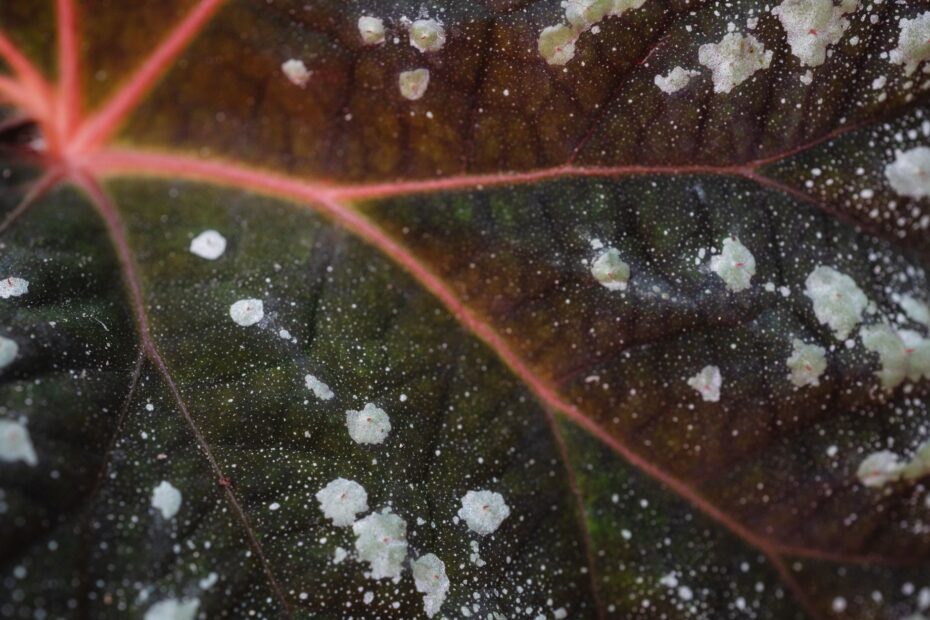
More than 1,000 host-specific fungal species release airborne spores and thrive in humid air around susceptible foliage. Your leaves do not need standing water for infection to begin. White dust can appear on roses, squash vines, or houseplants after several warm, still days.
This explanation helps you identify the fungus, trace the growing conditions behind it, protect nearby plants, and choose between pruning, isolation, or disposal.
White Surface Growth Distinguishes Powdery Mildew From Similar Problems
Pale, round flecks are usually the earliest visible sign. The spots thicken into white or gray, talc-like growth on upper leaf surfaces, stems, buds, flowers, and, on some crops, fruit. Your newest shoots can curl, yellow, or grow in a distorted shape.
Surface texture separates powdery mildew from several look-alikes. Powdery growth rubs away partly, but a faint stain and active growth remain beneath it. Dust wipes off cleanly, while hard-water residue leaves a crusty ring where droplets dried.
| What you see | Likely cause | What it means for your next move |
|---|---|---|
| Your leaf has soft white-gray powder on both sides. | Powdery mildew | Inspect airflow, spacing, light, and nearby host plants. |
| Your leaf has yellow angular spots with gray fuzz below. | Downy mildew | Focus on leaf wetness and cut away badly marked foliage. |
| Your leaf wipes clean without a stain. | Dust or soil splash | Rinse gently and watch for new patches over 3 days. |
| Your stem holds cottony clumps. | Mealybugs | Inspect crevices and address insects rather than changing humidity. |
| Your leaves carry fine silk and stippled dots. | Spider mites | Inspect undersides closely and separate the plant from your collection. |
Downy mildew is a different disease. It grows inside leaf tissue and needs wetter conditions, while powdery mildew sits on the plant surface like thin felt. That visible coating points to a fungus growing outside the leaf.
Erysiphales Fungi Form the Powdery Coating
Under a hand lens, the white coating appears as living fungal growth rather than bacteria, viruses, insects, or poor housekeeping. Fine threads feed from the surface, while upright structures release spores into the air. Your plant shows powder because the fungus is reproducing in plain sight.
Host Preference Narrows the Spread Pattern
Each mildew species favors certain hosts. The strain on your rose rarely jumps to every nearby herb or houseplant, yet another Erysiphales species can attack begonia, lilac, phlox, cucumber, or zinnia. Susceptible plant varieties give spores a more suitable landing place than resistant varieties.
That host preference explains a familiar garden scene. One squash leaf turns white while nearby basil stays clear. You do not need to fear every plant equally; inspect related hosts and plants with a record of past outbreaks.
A spotted peony stem is a concern for other peonies and related susceptible ornamentals, not proof that every container on your patio faces infection. Guidance from University of Minnesota Extension describes this host link and its role in sanitation choices.
Even on a compatible plant, infection takes hold only when the surrounding air favors spore germination.
Humid Air Lets Spores Grow on Dry-Looking Leaves
Warm daytime and cool nighttime temperatures leave humid air around foliage, even while leaf surfaces feel dry. That pattern explains why powdery mildew develops without wet leaves: spores can germinate in high humidity without standing water. Your evening watering habit is not the only cause.
Leaf Wetness Does Not Explain Every Outbreak
Several leaf diseases need water droplets to enter tissue, so overhead watering gets blamed for every white patch. Powdery mildew works differently. Long periods of damp foliage can stress plants and invite separate diseases, but dry-looking leaves do not rule out this fungus.
Water in the morning and direct water at the soil rather than foliage. Your goal is not bone-dry air, but shorter humid periods trapped among leaves and stems.
A shaded bed beside a fence shows the pattern clearly. Air cools there after sunset, humidity rises between crowded stems, and spores gain hours of favorable conditions. That same pocket becomes more serious after colonies begin releasing fresh spores.
Airborne Spores Carry Infection Between Suitable Hosts
A light breeze, box fan, sleeve brushing a stem, or open window can carry spores from one leaf to another. How powdery mildew spreads depends on ordinary air movement, not rain alone. Your hands and pruning tools can shift spores after contact with a coated shoot.
- Spore lands: A fungal spore settles on suitable tissue during humid weather and begins surface growth.
- Colony expands: White growth produces fresh spores that lift away with moving air.
- Hosts receive spores: Related susceptible plants face the highest exposure in your bed or room.
- Debris holds spores: Infected buds, stems, and fallen leaves shelter overwintering inoculum for a later outbreak.
- Conditions repeat: Dense growth and humid nights restart the cycle around your plants.
Not every landing spore begins an infection. Host fit, leaf age, humidity, light, and plant vigor shape the result. Still, coated debris beneath a rose or cucurbit gives your next growing season a loaded starting point.
Crowding, Shade, and Nitrogen Feed Vulnerable Growth
A dense canopy holds moisture like a closed closet after a shower. Tight spacing, shade, and poor air circulation slow drying around leaves, leaving your foliage in the humid zone powdery mildew favors. Soft new growth adds another weakness.
Nitrogen Fertilizer Produces Tender Shoots
Rapid, lush growth from excess nitrogen has thinner, more vulnerable tissue. It also packs leaves together and slows air exchange. Your tomato or rose does not need starvation, but repeated high-nitrogen feeding can turn a small patch into a recurring problem.
| Site condition | Why it feeds outbreaks | Correction for your plants |
|---|---|---|
| Your plants touch at maturity. | Stems trap humid air. | Space containers or thin selected stems. |
| Your bed stays in deep shade. | Foliage dries slowly and grows thin. | Shift pots or prune nearby shading growth. |
| Your room has still air. | Spores linger around grouped leaves. | Use gentle air movement away from direct drafts. |
| Your fertilizer is nitrogen-heavy. | Rapid, soft shoots invite infection. | Pause extra feeding and follow label rates later. |
| Your variety repeats the problem. | Its genetics offer limited resistance. | Choose resistant varieties for your next planting. |
| Your debris stays below plants. | Old tissue holds seasonal spore sources. | Bag and discard marked leaves and stems. |
Site corrections lower disease pressure before a labeled spray enters the picture. Integrated pest management centers on spacing, light, sanitation, and careful fertilizer use. Guidance from University of California Agriculture and Natural Resources follows that approach.
Indoor Plants Form Their Own Humid Microclimate
A cluster of houseplants near a dim window can form a still, humid pocket. Powdery mildew on indoor plants can move from a coated begonia or African violet to another susceptible plant through fan currents and routine care. Your home has its own weather pattern.
Separation Limits Close-Range Exposure
Place the affected pot away from nearby susceptible plants as soon as powder appears. Give it bright indirect light suited to its species, wider spacing, and gentle airflow. Your humidity-loving calathea still needs humidity, so reduce crowding before drying the entire room.
Three pots pressed together above a radiator show how this starts. Warm daytime air meets cool window glass at night, local humidity swings sharply, and leaves barely move. Separating the pots by several inches changes the air around your plants without harsh drafts.
Better airflow slows new growth, while containing existing colonies prevents them from reseeding nearby leaves.
Keep a fan far enough away that leaves do not whip and soil does not dry rapidly. Gentle circulation refreshes air; a constant blast stresses foliage and carries loose spores farther.
Prompt Isolation and Pruning Can Preserve an Infected Plant
A few fresh patches rarely mean the plant is beyond recovery. Fast action lowers the spore source before colonies cover new tissue. Your goal is to slow spread while changing the conditions that allowed infection.
- Separate the pot: Place your affected plant away from susceptible neighbors until fresh powder stops appearing.
- Cut coated tissue: Trim heavily marked leaves or shoots with clean shears, leaving enough foliage for recovery.
- Bag debris: Seal cut material before disposal so loose spores do not drift through your space.
- Wash tools: Wash blades with hot soapy water, then dry them before touching another plant.
- Inspect close hosts: Look at related plants every few days for faint circles, curled tips, or gray dust.
- Correct the site: Give your plant suitable light, spacing, moderate feeding, and moving air.
Labeled sulfur products, potassium bicarbonate products, horticultural oils, and other mildew-control sprays fit into that broader approach. Coverage matters because surface colonies sit where the spray must reach. Follow the label for crop use, temperature limits, repeat timing, and harvest intervals on edible plants.
Do not coat a heat-stressed plant at midday. Oils and sulfur products can mark foliage under hot, bright conditions, and sulfur should not follow an oil application within the label’s stated interval. Your label controls the application details, not a household recipe.
Recurrence and Severity Shape Disposal Choices
Repeated outbreaks point back to spores and the microclimate around the same plant. Resistant varieties, adequate spacing, selective pruning, suitable light, moderate fertilizer, and infected-debris disposal lower the chance of recurrence. Your strongest response starts before the next white patch appears.
Dish Soap Does Not Offer Dependable Control
A kitchen-sink surfactant like Dawn is not a dependable mildew-control product. Strong soap mixtures can burn foliage, strip protective leaf surfaces, and leave damaged tissue that resembles disease injury. Avoid kitchen formulas unless a plant label or local extension source gives crop-specific directions.
Keep working with a plant that has a few affected leaves, solid new growth, and a site you can correct. Prune harder where colonies cover several shoots but healthy buds remain lower on the plant. Discard a badly coated specimen after repeated outbreaks where recovery would require cutting away most foliage.
What causes powdery mildew on plants is more than a white mark. It is a living spore cycle meeting a favorable host in a humid, crowded place. Your disposal choice should interrupt that cycle rather than punish a plant for a single patch.
Final Thoughts
Powdery mildew gains ground through host-specific fungi, airborne spores, humid air, and a canopy that stays still and crowded. Locate the source, cut away the heaviest colonies, and change the conditions around your plants. Your most useful step is a less welcoming place for the next spore to settle.
FAQ
How do you get rid of powdery mildew on plants?
Cut heavily coated leaves and shoots, isolate the plant, bag debris, and wash your tools before moving to healthy foliage. Then correct your plant’s spacing, light, airflow, and fertilizer routine. A labeled mildew-control spray can help on fresh infections, but repeat coverage follows the product label.
Does Dawn dish soap get rid of powdery mildew?
Strong Dawn mixtures can damage leaves without providing dependable control of powdery mildew. Soap can break surface tension, yet it does not address the growing conditions or spore source. Use a product labeled for your plant and follow its directions rather than mixing a concentrated household spray.
Can a plant with powdery mildew be saved?
Your plant can recover with infection caught while only a small share of leaves or shoots carries powder. Cut the worst tissue, separate the pot or plant, and improve light and air movement. Recovery becomes less realistic after repeated outbreaks strip most leaves or distort most new growth.
Should I throw away a plant with powdery mildew?
Keep a plant with a limited infection where you can cut affected tissue and change the conditions around it. Discard a severely coated plant that repeatedly infects nearby susceptible plants, especially in a crowded indoor collection. Bag it before disposal so spores do not drift onto your remaining plants.